
Decades of data haven’t ended racial disparities in Illinois traffic stops
The state started tracking traffic enforcement data in 2003 to curb profiling, but independent monitoring remains critical.
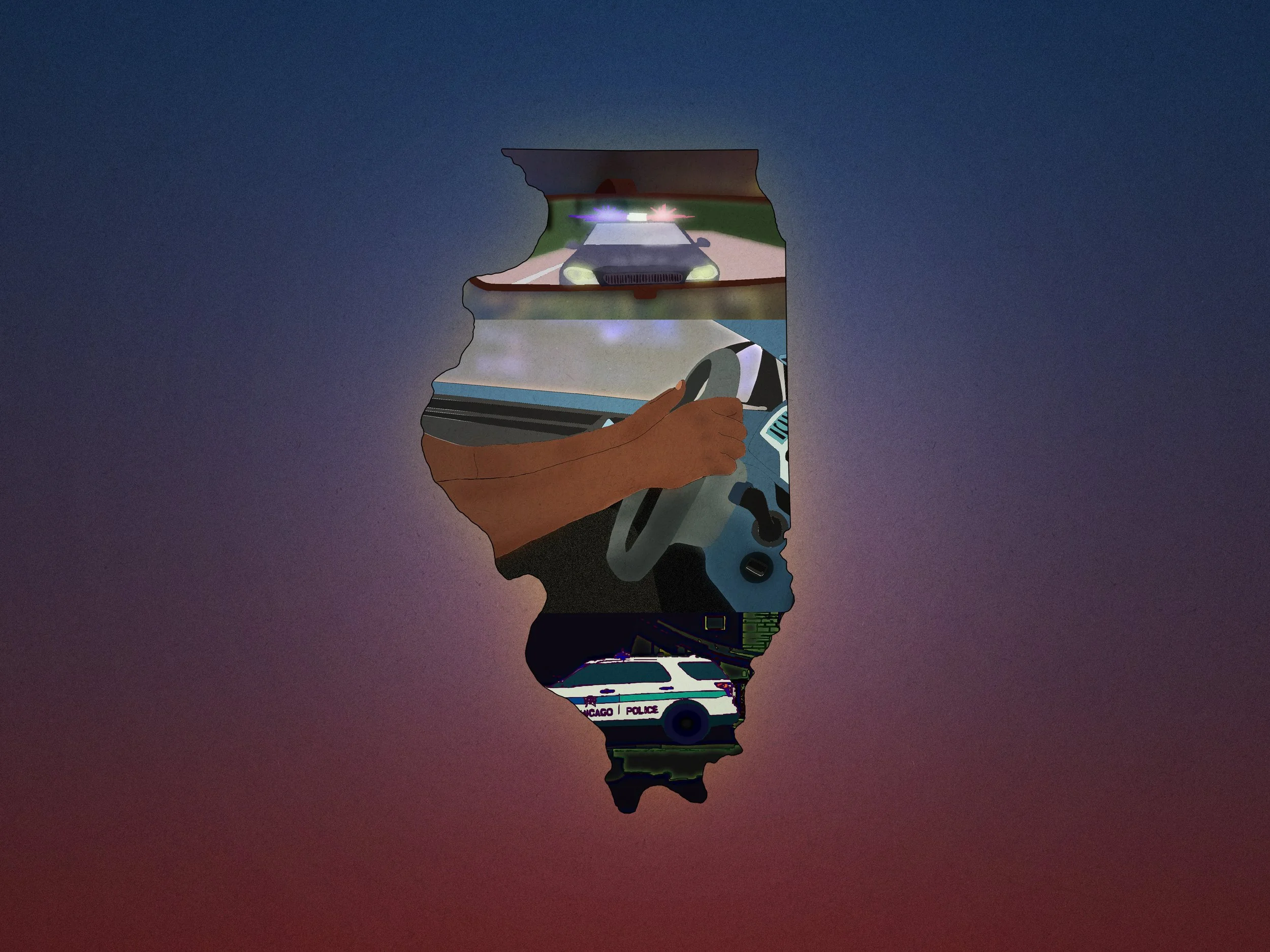
Illustration produced by Zahid Khalil and Andjela Padejski with WBEZ.
This is part of our ongoing coverage of traffic stops in Illinois.
By Tiasia Saunders
Black drivers in Illinois remained much more likely than white drivers to get pulled over and have their vehicles searched by law enforcement agencies last year, according to the latest traffic stop report by the Illinois Department of Transportation.
The report, which was released in early August, found that law enforcement agencies across the state stopped Black drivers at a 37% higher rate than white drivers and searched their vehicles at nearly twice the rate of white drivers.
The report’s findings were based on an analysis of more than 2 million traffic stops conducted in 2025. The transportation department has been collecting the data and producing annual reports on it for decades — as mandated by the Illinois Traffic Stop Statistical Study Act, a landmark state law passed in 2003 amid concerns about racial bias in traffic stops.
But the raw data on traffic stops has been elusive for a long time — that’s because the transportation department doesn’t regularly release it to the public, a practice that limited the ability of researchers and journalists to independently examine whether Illinois law enforcement agencies engaged in racial profiling during traffic stops.
Two years ago, the Investigative Project on Race and Equity, in partnership with WBEZ, decided to change this: We pooled our resources and worked together to make the traffic stop data readily available.
We obtained 42.5 million traffic stop records through Freedom of Information Act requests and posted them on an interactive dashboard, where users could explore enforcement patterns across Illinois and examine disparities by race, agency and year. Users could also download the data and documentation on how to use it.
We also analyzed the data to examine whether racial bias in traffic stops that alarmed lawmakers 23 years ago still existed. The resulting investigations found that traffic stops involving Black drivers continued to account for a disproportionate — and rising — share, making up 30.5% of all stops in 2022 (even though 13.6% of the state population is Black). We also found that one in five law enforcement agencies failed to meet the state’s reporting deadlines or submitted incomplete traffic stop data.
Last year, our follow-up investigation found that 230 traffic stops in Chicago resulted in injuries requiring hospitalization during the previous five years, with Black drivers involved in 81% of such cases. Another investigation found that, while Chicago police made fewer traffic stops in 2024, more cases resulted in violence, and that 85% of use-of-force incidents occurred in majority-Black and majority-Latino communities on the city’s South and West sides.
More from the newsroom:
Immigrants are finding success challenging detention in federal court
Chicago teens on ‘takeovers,’ curfews, and lost community spaces
Illinois tax sales get an overhaul, but how much will homeowners benefit?
Angela Caputo, former executive director of the Investigative Project, said these investigations highlight how independent journalism can play a critical role in shedding light on systemic issues such as racial bias in traffic stops.
“The state’s not looking at the data in the same way. … Each year, the state will put out a report, and it says some variation of almost the same thing,” Caputo said. “But looking at that over time, we were able to see that the rate of … Black drivers who were stopped had nearly doubled over two decades, and that was just a shocking statistic.”
Ed Yohnka, director of communications at American Civil Liberties Union of Illinois, said having an ongoing, independent scrutiny of traffic stop data is critical because it can lead to conversations that need to be had in the communities.
“If the data shows that drivers of color are more likely to be stopped and searched (compared to white motorists), law enforcement leaders ought to explain why that is happening and what the data means to them,” Yohnka said in an email. “That conversation can be a catalyst for changing policies — policy changes that can then be examined for whether they have brought improvement to the rate of stops in a community.”
The Investigative Project has obtained the 2025 traffic stop data and plans to publish follow-up stories in the coming weeks.
Tiasia Saunders is the Investigative Project’s summer 2026 Dow Jones Investigative Intern. Her internship is generously funded by the Chicago Headline Club, which is a chapter of the Society of Professional Journalists.