
How journalists can verify and use images responsibly in reporting
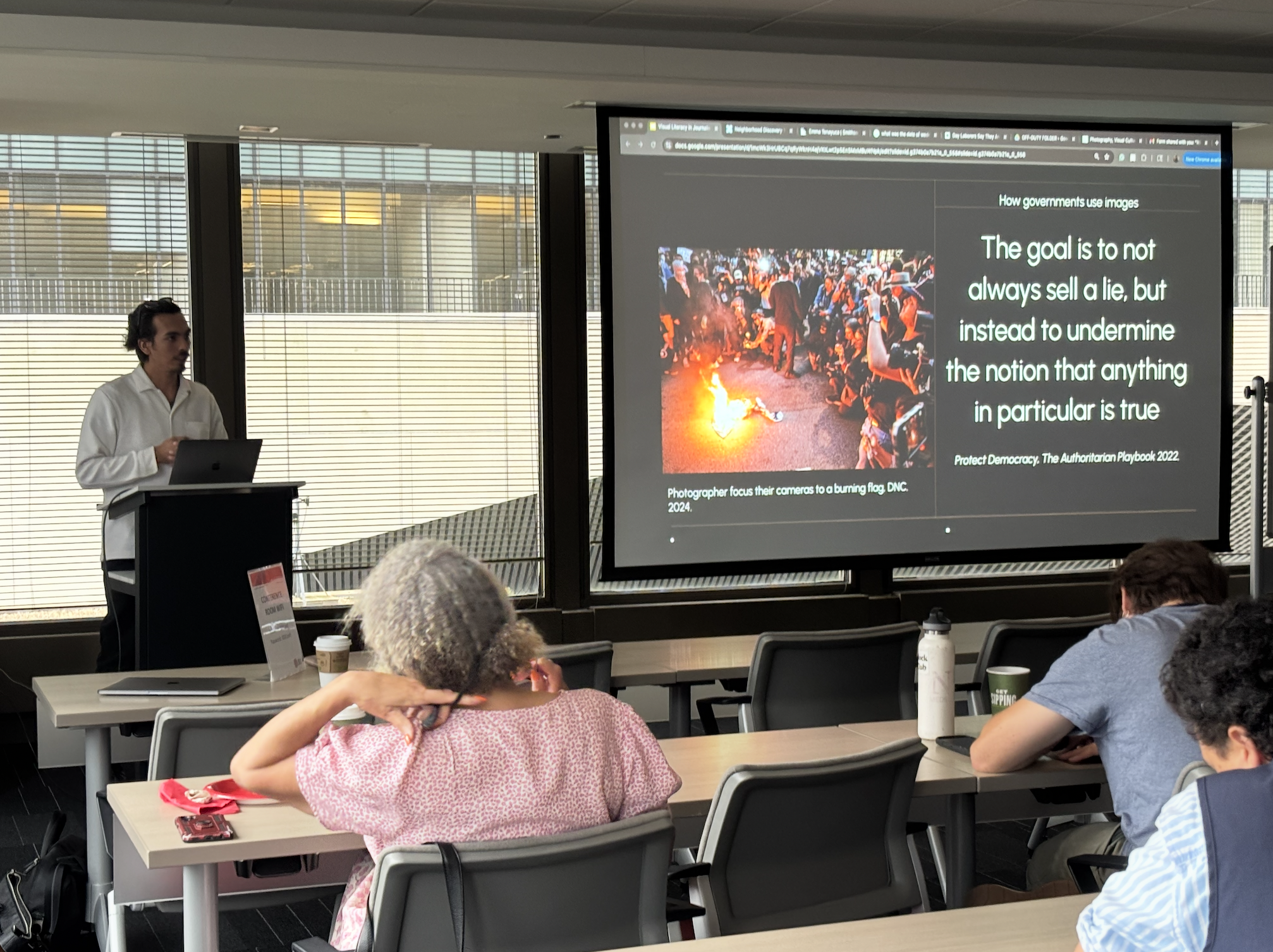
More than 25 people attended the Visual Literacy in Journalism training on Aug. 18, 2025 at the Simmons Center for Global Chicago | Provided
By Jake Wittich
Images are often treated as proof, but photographs and videos can be miscaptioned, recirculated or stripped of context — even when they are real.
Before relying on visuals in reporting, journalists need to confirm where they came from, what they show and how they are being interpreted. Answering those questions is part of a reporting process known as verification.
This guide draws from a visual literacy training held Aug. 18, 2025, at the Simmons Center for Global Chicago and led by investigative reporter and photographer Sebastián Hidalgo for the Investigative Project on Race and Equity.
The training, attended by 25 Chicago-area reporters, photo editors and audience journalists, focused on the steps journalists use to verify images and use them responsibly.
Why verification matters
Visuals often travel faster than reporting. Images are shared across platforms, reused in new contexts and sometimes presented as representative of broader events.
Because photos capture specific moments, they can be accurate while still creating misunderstanding when key details — such as time, location or surrounding circumstances — are unclear.
Verification helps journalists determine not only whether an image is authentic, but whether it reflects the situation being described.
Start with basic verification questions
Image verification begins with foundational reporting questions that establish origin and context.
Journalists can ask:
Is this image authentic?
Who is in the image?
What is happening and why?
Where was the image taken?
When was it taken?
These questions help determine whether an image can support a story and what additional reporting is needed.
Verification is a key part of the reporting process.
How journalists confirm images
Answering basic verification questions often involves multiple methods rather than a single tool. Verification is strongest when these approaches are used together.
Reverse image search
Searching for earlier versions of an image can reveal when it first appeared, whether it has been reused and how it has circulated.
Metadata review
Available file data can provide clues about timing, device information or location, though metadata may be incomplete or removed.
Cross-referencing with reporting
Comparing images with eyewitness accounts, official information and other visuals helps confirm whether the scene matches the description.
Triangulation
Relying on multiple sources — visual and nonvisual — reduces the risk of drawing conclusions from a single frame.
When real images mislead
Authenticity does not guarantee accuracy in context.
Images can be:
Shared with incorrect captions
Presented as recent when they’re archival
Used to represent patterns despite showing isolated moments
Circulated without information about where or when they were taken
These context failures can shape public understanding even when the underlying image is real.
Confirming timeline, location and relevance helps prevent overstating what visuals show.
Ethical use of visuals
Verification addresses whether an image is reliable. Editorial judgment addresses whether it should be used.
Journalists may consider:
Whether subjects understood they were being photographed
Potential harm to individuals or communities
Whether an image amplifies stigma or misinformation
Whether visuals are being used as proof for claims they cannot support
Responsible use means balancing informational value with dignity, accuracy and potential impact.
Takeaway: A verification workflow
Before publishing or relying on an image, journalists can:
Identify where the image came from
Confirm when and where it was taken
Compare it with other reporting and visuals
Assess whether it reflects the situation being described
Consider potential harm and editorial purpose
Verification does not end with authenticity. It continues through context, interpretation and use.
Applying these steps helps ensure visuals are used alongside reporting rather than as standalone proof.
This article includes tools, guidance and insights developed through Investigative Project trainings. Explore our trainings page for additional resources and upcoming journalism trainings from the Investigative Project and other organizations.
We are a nonprofit newsroom.
Please support our work to train the next generation of journalists.