
How images shape narratives: a guide to reading photographs critically
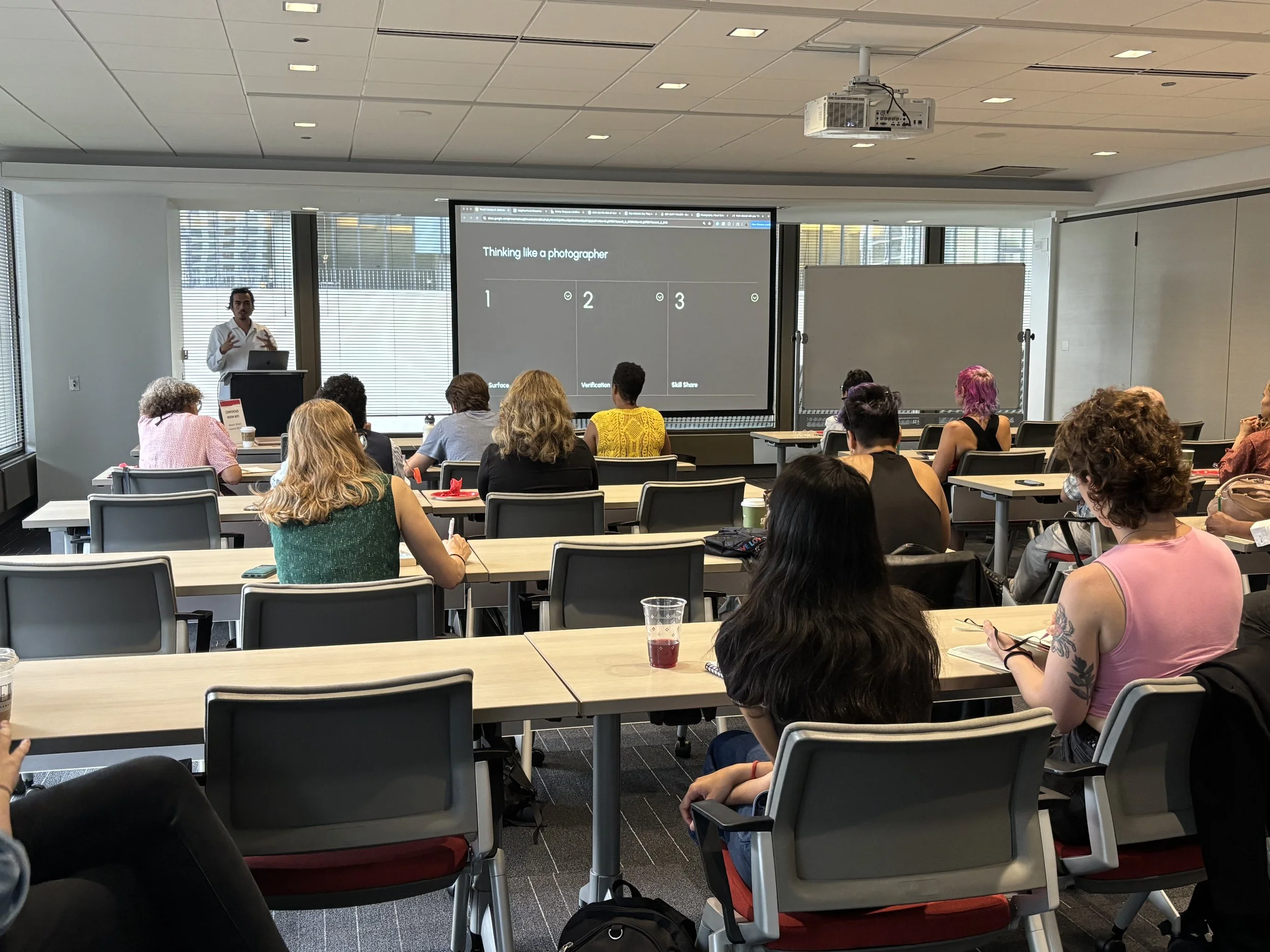
More than 25 people attended the Visual Literacy in Journalism training on Aug. 18, 2025 at the Simmons Center for Global Chicago | Provided
By Jake Wittich
Photography documents moments, but it also constructs meaning.
Choices about framing, timing, selection and repetition shape what audiences believe they are seeing. Recognizing those dynamics is a core reporting skill that can prevent a single image from shaping a story without context.
This guide draws from a visual literacy training held Aug. 18, 2025, at the Simmons Center for Global Chicago and led by investigative reporter and photographer Sebastián Hidalgo for the Investigative Project on Race and Equity.
The training, attended by 25 Chicago-area reporters, photo editors and audience journalists, explored how photography influences public understanding and why journalists must interpret images with the same scrutiny applied to text, data and sources.
Images play a role in narrative cycles
Visual coverage influences how events are interpreted, how institutions respond and how future coverage is framed.
A single event is photographed and circulated, often with emphasis on visually dramatic moments. Those images can create a sense of urgency that shapes public conversation and influences how decision-makers respond. The response — whether policy changes, official messaging or additional coverage — then generates new imagery that reinforces the original narrative.
When certain types of images are repeatedly associated with an issue, they can reinforce particular storylines and shape public expectations.
These feedback loops help explain how visual misinformation can shape understanding even when images themselves are accurate.
Style and perspective shape what audiences learn
Visual impact and informational value are not always the same. Dramatic images can draw attention, but they can also narrow understanding by emphasizing peak moments rather than surrounding conditions.
Perspective — where the camera is positioned and what it captures — plays a central role in how audiences interpret events.
Recognizing how composition guides attention helps clarify what an image communicates and what it leaves unexplored.
Questions to consider when examining an image:
What is the photographer trying to show?
How does composition direct attention?
What context might not be visible?
What do images leave out?
A photograph captures a limited moment from a single vantage point. Selection and cropping determine what becomes visible and what remains outside the frame—choices that can influence how audiences interpret a scene.
Alternate frames, wider shots or additional visuals may complicate the story suggested by a single image.
Asking what might be absent from a photo helps surface missing context and reduces the risk of drawing broad conclusions from a single frame.
Visual narratives have historical precedent
Photography has long been used to stage, simplify or reinforce stories about communities, conflict and institutional power. Historical imagery demonstrates how photographs can reflect the priorities of those producing or distributing them.
Staged portraits, curated scenes and how widely an image is circulated can contribute to enduring visual narratives that continue to shape contemporary coverage.
Not every photo from an event spreads equally. The images that get picked up, reposted, placed on front pages or amplified on social media end up defining how the event is remembered.
Recognizing these patterns helps journalists understand how today’s images connect to past ways of portraying people and events.
Takeaway: How to read images more carefully
Photos don’t show what happened — they show one version of what happened. Journalists need to examine perspective, what’s included and what’s missing to understand what a photo can and cannot explain.
When reviewing images, journalists can ask:
What is the photographer trying to show?
What is happening and why?
Who is in the image and what context is missing?
What might be outside the frame?
These questions help journalists avoid treating a single image as proof and instead use it as a starting point for additional reporting and context.
Reading images this way supports more accurate coverage and better editorial decisions.
This article includes tools, guidance and insights developed through Investigative Project trainings. Explore our trainings page for additional resources and upcoming journalism trainings from the Investigative Project and other organizations.
We are a nonprofit newsroom.
Please support our work to train the next generation of journalists.