
Steps Illinois lawmakers could take to reform the state’s tax sale laws
Efforts in other states offer road maps for improving outcomes for homeowners and addressing the harms of tax foreclosure.
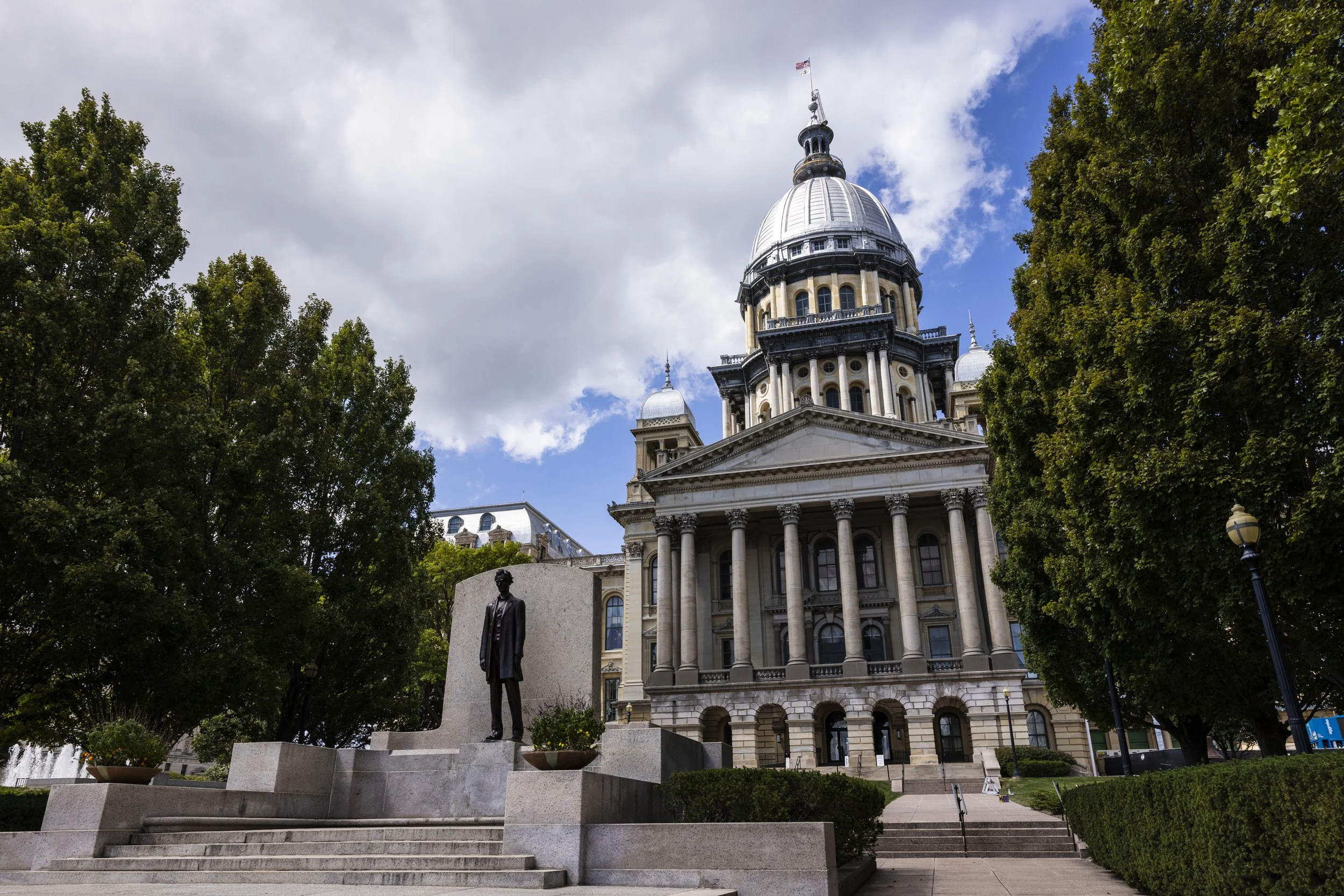
Illinois is the last state in the nation to adopt reforms aimed at giving homeowners their fair share of tax sale proceeds. | Ashlee Rezin/Sun-Times
By Emeline Posner
This is a joint project of Injustice Watch and the Investigative Project on Race and Equity. Read previous stories in this series here.
The Illinois General Assembly is considering a trio of bills that would amend the state’s tax sale laws to make sure that homeowners are fairly compensated when their properties are seized for delinquent property taxes.
Under current tax sale laws, private investors can purchase homeowners’ tax debts from counties, impose interest and fees, and go to court to seize properties — and pocket their full value — if the owners fail to pay off what they owe within a 30-month grace period.
From 2019 to 2024, private investors seized more than 1,000 owner-occupied properties in Cook County — most of them in predominantly Black communities — through this tax sale system, according to an investigation last year by the Investigative Project on Race and Equity in partnership with Injustice Watch. The news organizations also found that the county’s lax oversight has failed to prevent alleged fraud and misuse of the tax sale system.
Under the most sweeping of the three bills, SB3940, sponsored by state Sen. Celina Villanueva, D-Chicago, private investors would no longer be able to purchase tax debts in Cook County; instead, the county would be required to sell tax-delinquent properties at auction to collect taxes and return any proceeds that remain to homeowners. Other counties would also be allowed — though not required — to hold similar auctions.
Villanueva’s bill, which is awaiting a committee hearing, was introduced in February, two months after a U.S. District Court judge ruled that the tax sale system in Cook County violated the rights of homeowners by allowing private investors to seize more than what the owners owed.
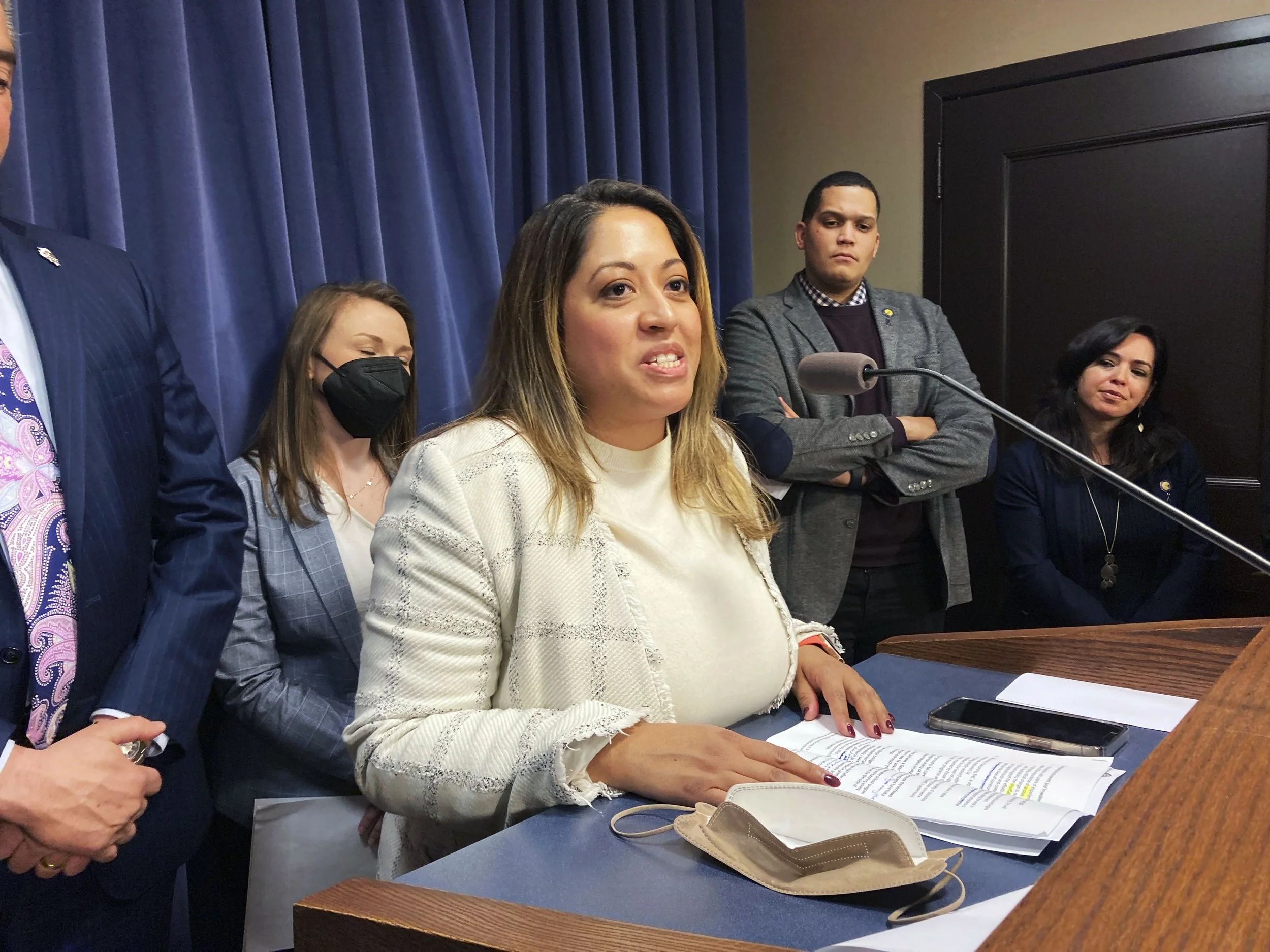
In this year’s legislative session, state Sen. Celina Villanueva, D-Chicago, is pushing for a tax sale law reform. | John O'Connor / AP
In a statement, Villanueva said the changes proposed in her bill “will help families stay in their homes when possible, and when foreclosure is unavoidable, they’ll walk away with the equity they’ve built rather than losing it entirely.”
But advocates say that while holding auctions would be a positive step, lawmakers should also consider additional measures adopted by other states to protect homeowners from the harms of tax foreclosure.
“Illinois is the last state in the country to respond to” the issue of homeowners’ lost equity, said Mallory Verez, legal fellow at public-interest law and policy group Impact for Equity and author of a recent report on Illinois’ tax sale laws. “But we can still be a leader in this space by pursuing reform that is more comprehensive and all encompassing and protective of homeowners than some of the other states have been.”
Some notable measures include:
Ensuring properties in tax foreclosure auctions are sold at their market value
Other states have started holding auctions for tax-delinquent properties in recent years. But such auctions don’t always lead to sales at properties’ market value, advocates say.
To ensure homeowners receive the maximum amount of equity back, Verez said Illinois lawmakers could look to states like Minnesota and Oregon, which mandate that bidding for tax foreclosure auctions begin at properties’ fair market or appraised value.
Currently, Villanueva’s bill sets the starting bid for tax-delinquent properties at auction at the amount of tax debt, plus fees and fines.
Verez said setting a higher starting bid sets higher standards for auction bidders. Otherwise, she said, “You could always end up in a system where people are just trying to go for the lowest bid possible.”
But the bill’s backers expressed optimism that tax foreclosure auctions without a higher starting bid can still generate close to market value for habitable, owner-occupied properties.
Justin Kirvan, policy director for the Cook County Treasurer’s Office, said the county should hold auctions using “closed-envelope” bidding, which requires bidders to enter their best and final offer from the get-go without seeing the prices offered by competitors.
“Auction participants will bid the maximum they’re willing to pay for the property without inspecting it,” said Kirvan, who is part of a coalition of county agencies and advocacy groups backing Villanueva’s bill. “Provided the auction is online and well-advertised, sealed-envelope bidding should be robust, and many sale prices should approach market value.”
Preventing foreclosure by reducing tax burden
In Minnesota, a property tax “circuit breaker” program helps thousands of low- and middle-income homeowners reduce their tax burden.
Under the program, homeowners who earn up to about $135,000 and have tax bills that exceed a certain percentage of their annual income — ranging from 1% to 2.5%, depending on income level — could get their tax reduced and receive a refund of up to $3,310 from the state. Homeowners who saw an increase of 12% or more in their tax bill from one year to another could also qualify for the program.
Circuit breaker programs like Minnesota’s are particularly effective in reducing tax burdens for low- and middle-income homeowners, who, studies show, pay a greater share of their income on property taxes than wealthier homeowners do.
A 2024 report by the Minnesota Department of Revenue found that the program did exactly that: reducing the very-low-income households’ property tax from 5.5% of their income to 3.9%. Meanwhile, the highest-income households paid just 1% of their income on property taxes.
A well-crafted circuit breaker policy can increase housing affordability and help protect some homeowners from tax foreclosure, said Brakeyshia Samms, senior analyst for the Institute of Tax and Economic Policy, a nonprofit research group based in Washington, D.C.
“The way to really think about it is like a traditional electrical circuit breaker,” Samms said. “It’s protecting families from property tax overload.”
Currently, 28 states and Washington, D.C., have some form of circuit breaker written into law, according to a 2023 report coauthored by Samms.
Last year, state Sen. Willie Preston, D-Chicago, introduced a bill to establish a program that would refund households spending more than 5% of their income on property taxes.
Preston called the bill, which has been carried over to this year’s legislative session, a “triage” response to destabilizing forces, including Cook County’s tax sale system, that have provoked a housing crisis in the communities he represents.
“Working-class taxpayers,” Preston said, “work hard for their little pieces of heaven on earth” and deserve a more “preventive and equitable system” that would keep tax dollars flowing to local governments while giving some relief and flexibility to homeowners.
Allowing payment plans for struggling homeowners
In Michigan, state law allows local governments to create payment plans for low-income homeowners who fall behind on their property taxes.
Homeowners approved for a payment plan could get the interest on their tax debt reduced and have up to five years to pay off the total amount due.
Similar programs are also offered in communities across the country. In Milwaukee, for instance, homeowners can opt for a 10-month, interest-free payment plan to spread their current property tax bills into smaller installments. In Philadelphia, homeowners can apply for a payment plan for delinquent property taxes and then bundle upcoming bills into their monthly payments.
But what sets Michigan’s program apart from those offered elsewhere and makes it more effective is that it takes into consideration homeowners’ income and ability to afford monthly payments, said Matt Kreis, general counsel for Center for Community Progress, a Washington, D.C.-based nonprofit focused on property revitalization.
“‘What is that monthly payment?’ is one of the questions that you have to look at,” Kreis said. “How is that affordable for this person? Are they playing catch-up? How are they going to be able to afford that monthly payment and whatever the next year’s taxes are going to be?”
Excluding the most vulnerable from the tax sale process
Under city ordinance, tax sales in New York City must exclude properties owned by seniors or disabled homeowners.
Cook County Public Guardian Charles Golbert said Illinois lawmakers could consider following New York City’s example — and also look at a more targeted measure that would protect homeowners living with cognitive disabilities, such as Alzheimer’s.
Golbert said his office has seen countless cases of longtime homeowners developing dementia, failing to pay their property taxes and then losing their houses — without understanding what’s happening until it’s too late.
As a fix, Golbert said, lawmakers should bar tax foreclosures when homeowners “lack capacity” due to a cognitive disability. As a precaution, he said Illinois should also consider allowing homeowners or their advocates to file a petition to reverse tax foreclosures if homeowners lack capacity.
“I feel this is a fair, balanced approach that would go a long way to protect people with cognitive disabilities,” Golbert said.
Reducing interest rates charged by private investors
In Illinois, when private investors purchase tax debts, they can charge homeowners up to 9% in interest. Under state law, that interest rate goes up every six months — and could rise as high as 45% in the span of the 30 months homeowners have to pay back their tax debt.
Verez of Impact for Equity said she knows of no other state that allows interest rates to increase this way.
To help struggling homeowners, Verez said Illinois lawmakers could follow other states’ examples by doing away with compounding interest rates. “If the goal is to have these homes on the tax rolls and having their property taxes paid, one would think that the way to do that was to get people paid up, and not to pile as many fines and fees and interest rates” on homeowners, she said.
Illinois could also lower the interest rate — currently 12% — that can be charged by private investors when they have to pay property tax bills on behalf of homeowners during the 30-month grace period, Verez added.
Meanwhile, other advocates have set their sights higher: a new system in which counties aren’t required by law to auction off tax debts to private investors in the first place.
Bob Palmer, policy director of Housing Action Illinois, a statewide coalition of affordable housing advocates, said this approach would mean fewer fees and interest charges for homeowners and more discretion to counties to offer longer-term payment plans.
“We think the system should be totally focused on helping people avoid that worst-case scenario,” in which homeowners lose their homes and built-up equity to investors, Palmer said.
Villanueva’s bill, if passed, would do what Palmer is pushing for — at least in Cook County.
But it remains to be seen whether Villanueva’s bill can get support from private investors, who invest tens of millions of dollars annually in the Cook County tax sale alone. The Illinois Tax Purchasers Association, an industry group representing private investors, did not respond to repeated requests for comment.
“My understanding is that the bill … has support from nearly every interested stakeholder except for the tax lien industry,” Verez said. “I'm hoping that the support of so many other parties will outweigh any pushback we receive from the tax purchasers.”
Carlos Ballesteros contributed reporting.